Both are nickel-chromium-molybdenum alloys. C22 has more chromium and does better in oxidising conditions, while C276 is often chosen for reducing environments and for pitting and crevice corrosion resistance.

A flange is only as reliable as the bolts holding it together. In plants that handle hot acids, wet chlorine or chloride-rich process streams, a stainless steel bolt can corrode and fail long before the pipe it clamps. That is why engineers specify Hastelloy C276 fasteners for the joints that cannot be allowed to leak. This guide explains what the alloy is, what its fasteners can and cannot do, which standards apply, and what to confirm before you place an order.
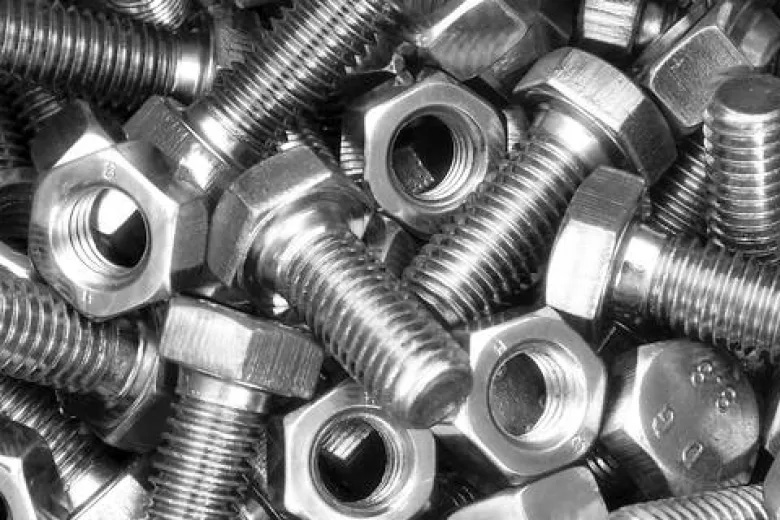
Hastelloy C276 (UNS N10276, Werkstoff 2.4819, also written Alloy C276) is a nickel-molybdenum-chromium alloy with a small tungsten addition. Nickel makes up the balance, at roughly 57%. Molybdenum and chromium give it resistance to both reducing and oxidising environments, which is unusual, because most alloys favour one or the other. Very low carbon and silicon keep carbide precipitation in the weld zone to a minimum, so welded equipment can generally be used without a post-weld solution anneal.
| Element | Limit (percent by weight) |
|---|---|
| Nickel | Balance |
| Molybdenum | 15.0 to 17.0 |
| Chromium | 14.5 to 16.5 |
| Iron | 4.0 to 7.0 |
| Tungsten | 3.0 to 4.5 |
| Cobalt | 2.5 maximum |
| Manganese | 1.0 maximum |
| Vanadium | 0.35 maximum |
| Silicon | 0.08 maximum |
| Carbon | 0.010 maximum |
| Phosphorus | 0.04 maximum |
| Sulphur | 0.03 maximum |
Some older data sheets show 0.02% carbon. Check the limit in the edition of the standard named on your order.
| Property | Typical value |
|---|---|
| Density | 8.89 g/cm³ |
| Melting point | About 1370 °C |
| Tensile strength, annealed bar | About 758 MPa |
| 0.2% yield strength, annealed bar | About 363 MPa |
| Elongation, annealed bar | About 62% |
| Hardness, annealed bar | About 88 HRB |
| Modulus of elasticity | 205 GPa |
These are typical values for annealed material, not guaranteed minimums. Specification minimums are set in ASTM B574, so check the current edition.
For fasteners, one point matters more than any table. C276 is not heat-treatable, so its strength rises with cold work. One wire data sheet shows yield strength climbing from 455 MPa with no cold work to 1310 MPa at 40% cold work, while elongation drops from 40% to under 4%. Cold-formed bolts and rolled threads can therefore be stronger than annealed bar, but strength varies with size and process. State the strength you need on the order instead of assuming a figure.
Fastener types and how they are made
Hindco Steel and Alloys lists Hastelloy C276 fasteners in these forms:
Small sizes are usually cold forged, larger sizes are hot forged, and special or low-volume parts are machined on CNC equipment. The product page lists BSW, UNC, BSF, UNF and metric threads, and head drives including six-lobe, Phillips and slotted.
Standards and designations you will see
Name the material standard, the dimensional standard and the thread on every enquiry, for example "hex bolt to ASME B18.2.1, UNC thread, ASTM B574 UNS N10276".
Where Hastelloy C276 fasteners are used
| Alloy | Known for | Think twice if |
|---|---|---|
| Hastelloy C276 | Wide resistance, including reducing acids, wet chlorine and pitting | The process is strongly oxidising, where C22 can do better |
| Hastelloy C22 | Higher chromium and better resistance in oxidising conditions | The process is mainly reducing, where C276 is often preferred |
| Inconel 625 | Good strength and general corrosion resistance | Chloride pitting and crevice attack are severe, as its molybdenum is lower |
| 316L stainless steel | Low cost for general service | Chlorides, heat or wet chlorine are present |
If your process chemistry is not fully known, ask your process engineer or the end user for the corrosion data before you finalise the alloy. A wrong fastener grade is cheap to prevent and costly to replace.
Before you order, confirm these points with your supplier:
Prices follow nickel and molybdenum market rates, and also depend on size, quantity, manufacturing route, testing and certification, so ask for a current quote rather than relying on an old price list.
Get a quote for Hastelloy C276 fasteners
Send us the fastener type, size, thread, material standard, quantity, certificate requirement and delivery country, with your drawing if you have one, and our team will prepare a quote for your requirement.
 India
 United States
 Saudi Arabia
 Kuwait
 Singapore
 Malaysia
 UAE
 Germany
 Italy
 China
 UK
 Canada
 Iran
 Thailand
 South Korea
 Turkey
 Morocco
 Costa Rica
 Kazakhstan
 Philippines
 Egypt
 Japan
 Russia
 Vietnam
 Australia
 Qatar
 South Africa
 Portugal
 Oman
 Jordan
 Spain
 Hong Kong
 Netherlands
 Indonesia
 Mexico
 Brazil
 France
 Taiwan
 Nigeria
 Bangladesh
 Iraq
 Ukraine
 Poland
 Romania
 Cyprus
 Angola
 Colombia
 Norway
 Chile
 Tobago
 Greece
 Czechia
 Belgium
 Sri Lanka
 Myanmar
 Venezuela