No. Monel is a nickel-copper alloy family, while Inconel is a nickel-chromium family. They suit different environments, so check the service conditions before swapping one for the other.

If you buy metals for a marine, chemical or oil and gas project, you have probably seen Monel 400 on a drawing. Engineers choose it when carbon steel rusts, copper wears away and stainless steel pits in chloride-rich water. This guide explains what the alloy is, how its round bars behave in service, where they are used, where they are not the right choice, and what to check before you place an order.
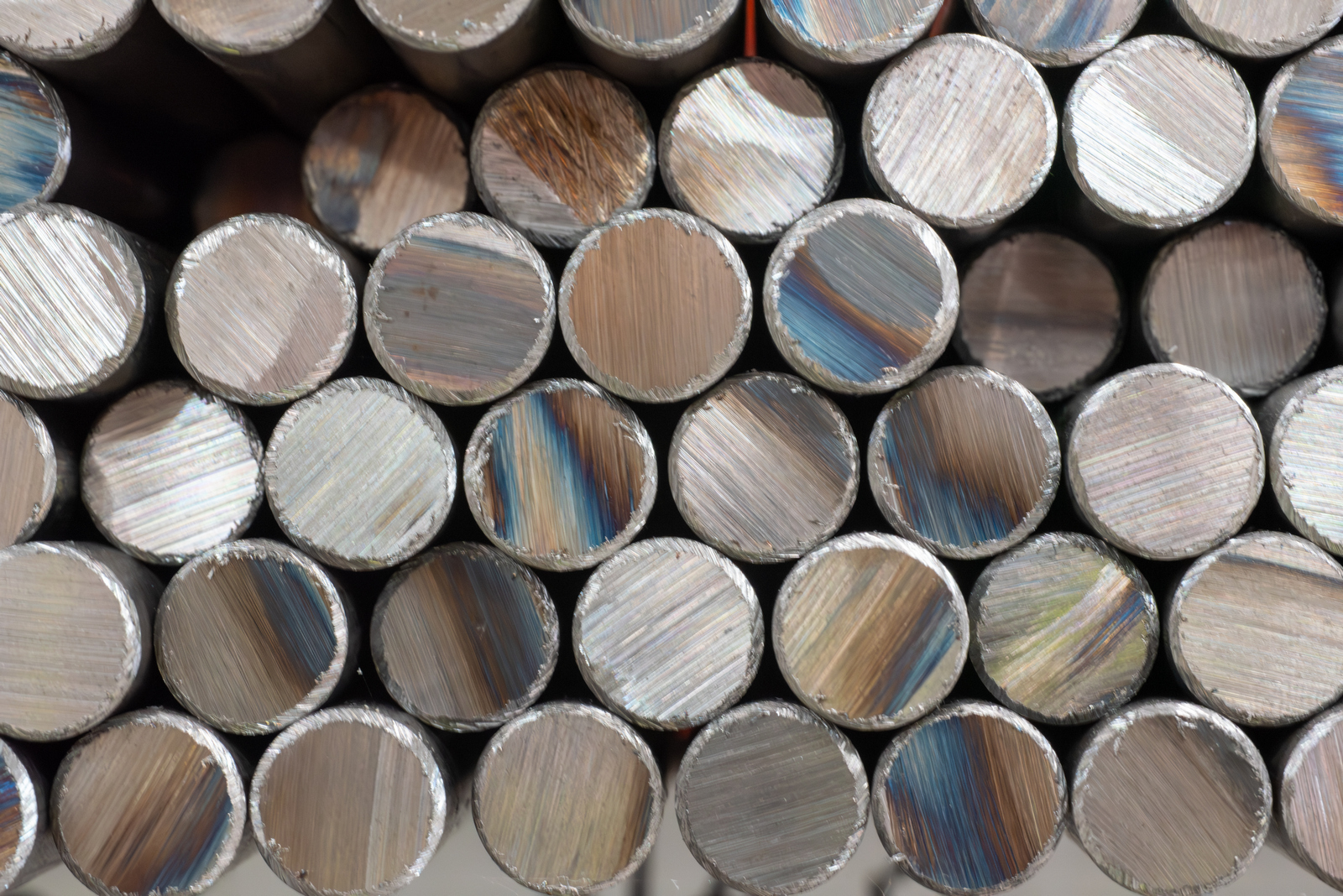
Monel 400 (UNS N04400, also sold as Alloy 400) is a nickel-copper alloy made of roughly two parts nickel to one part copper, with small amounts of iron and manganese. The two metals work together. The alloy resists corrosion better than either nickel or copper on its own, stays tough over a wide temperature range, and is generally free from chloride stress corrosion cracking, a failure that affects many stainless steels.
That combination explains why it shows up in ship fittings, pump shafts, valves and chemical plant, often in places where a failed part is expensive to replace.
| Element | Limit (Percent by Weight) |
|---|---|
| Nickel | 63.0 minimum, up to about 70 |
| Copper | 28.0 to 34.0 |
| Iron | 2.5 maximum |
| Manganese | 2.0 maximum |
| Silicon | 0.5 maximum |
| Carbon | 0.3 maximum |
| Sulphur | 0.024 maximum |
| Property | Typical Value |
|---|---|
| Density | 8.8 g/cm³ |
| Melting Range | 1300 to 1350 °C |
| Tensile Strength, Annealed | 485 MPa minimum |
| 0.2% Yield Strength, Annealed | 195 MPa minimum |
| Elongation, Annealed | 35% minimum |
| Hardness | About 110 to 160 HBW |
| Maximum Service Temperature in Air | About 480 °C |
These are published specification minimums for annealed material. Hot-finished and cold-drawn bars differ, and cold working raises strength sharply while reducing ductility. Always read the figures on the mill test certificate for the exact size and condition you are buying.
One caution applies to hydrofluoric acid service. In moist, aerated HF vapour, only annealed material resists stress cracking, so specify annealed bars for that duty.
Round bars are machined into shafts, studs, bolts, valve stems, bushings and pump parts. Typical industries include:
No alloy suits every environment, and a good supplier will say so.
| Feature | Monel 400 | Monel K-500 |
|---|---|---|
| Strengthening | Work hardening only | Precipitation hardened |
| Strength | Moderate | Higher |
| Best For | Corrosion-critical parts under moderate load | Shafts, fasteners and parts that need more strength |
| Corrosion Resistance | Excellent in seawater and hydrofluoric acid | Similar in many environments |
If corrosion resistance is the main concern and loads are moderate, Monel 400 is usually the more economical option. If a shaft or fastener must carry higher loads, K500 is worth the extra cost.
ASTM B164 covers nickel-copper alloy rod, bar and wire, and ASME SB164 is its counterpart for pressure code work. You may also see the alloy listed under these designations:
Check which designation your drawing or purchase order names, so the certificate matches it.
Hindco Steel and Alloys supplies Monel 400 round bars from 3 mm to 800 mm in diameter. Bars can be supplied hot-rolled, cold-drawn, bright-finished or forged, in lengths of 1 to 6 metres or cut to your size. Square, hex and flat bars, billets and forgings are also listed.
A wrong grade or condition costs far more than a short delay. Before you order, confirm these points with your supplier:
Prices move with nickel and copper market rates, and also depend on size, quantity, condition and certification, so ask for a current quote rather than relying on an old price list.
Send us the grade, diameter, length, quantity, condition and delivery country, and our team will prepare a quote for your requirement.
 India
 United States
 Saudi Arabia
 Kuwait
 Singapore
 Malaysia
 UAE
 Germany
 Italy
 China
 UK
 Canada
 Iran
 Thailand
 South Korea
 Turkey
 Morocco
 Costa Rica
 Kazakhstan
 Philippines
 Egypt
 Japan
 Russia
 Vietnam
 Australia
 Qatar
 South Africa
 Portugal
 Oman
 Jordan
 Spain
 Hong Kong
 Netherlands
 Indonesia
 Mexico
 Brazil
 France
 Taiwan
 Nigeria
 Bangladesh
 Iraq
 Ukraine
 Poland
 Romania
 Cyprus
 Angola
 Colombia
 Norway
 Chile
 Tobago
 Greece
 Czechia
 Belgium
 Sri Lanka
 Myanmar
 Venezuela