
- info@hindco.co.in
- 12th khetwadi cross lane, Mumbai 400 004.
- +91-9619035659
Stainless Steel 304 Pipes: Grades, Specifications, Uses and Buying Guide
Stainless steel 304 is the grade most plants default to when a line carries water, steam, food products or mild chemicals. It is easy to fabricate, widely stocked and well understood by inspectors. But "304" on a purchase order is only the start. Pipe standard, manufacturing route, schedule, finish and certification all decide whether the material works on site. This guide covers what procurement and project teams need to know before they order.
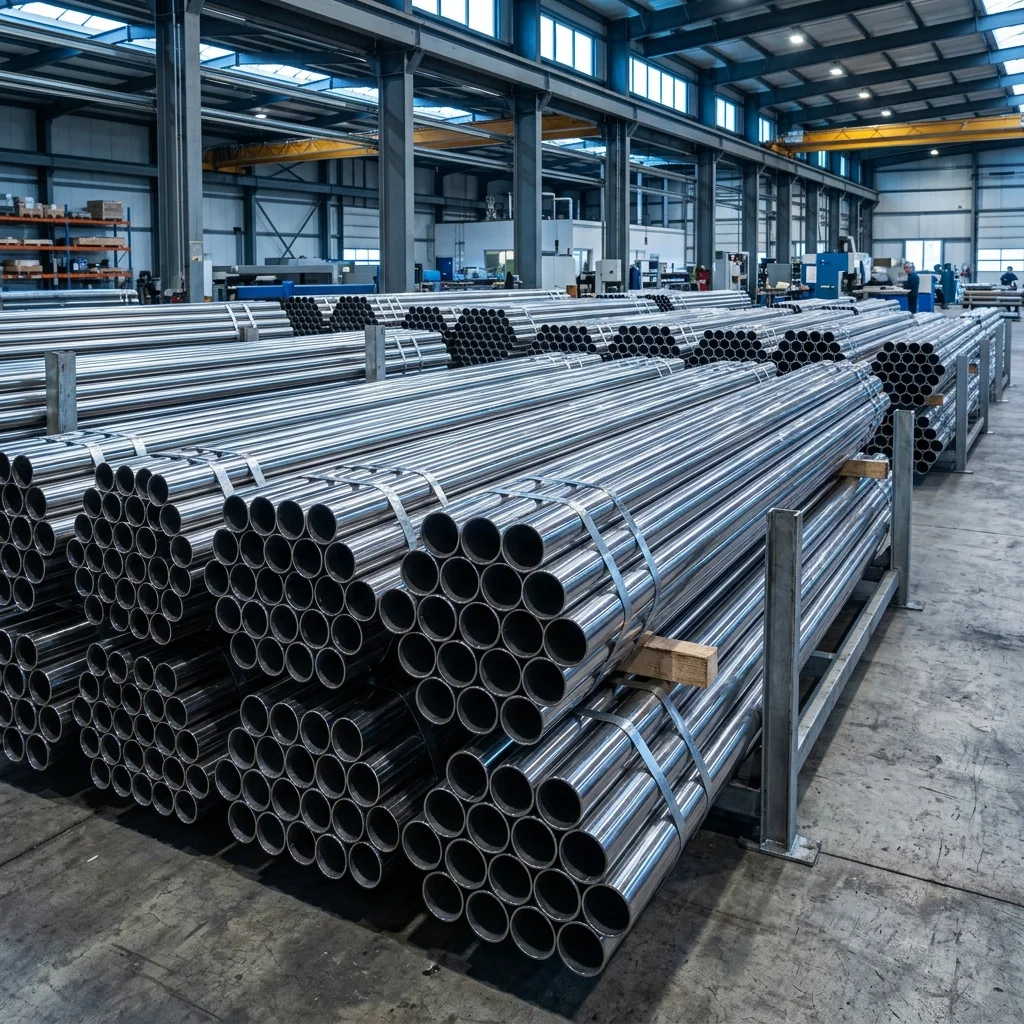
What are stainless steel 304 pipes?
SS 304 (UNS S30400, EN 1.4301) is an austenitic stainless steel containing about 18 to 20% chromium and 8 to 11% nickel. The chromium forms a thin protective oxide layer, and the nickel keeps the structure tough, formable and non-magnetic in the annealed state. It welds readily, handles low temperatures well, and has no molybdenum, which matters when you compare it with 316.
Pipe is made by two main routes. Seamless pipe is formed without a weld seam. Welded pipe is rolled from strip or plate and joined along a straight seam, then heat treated and finished.
Chemical Composition
| Element | Limit (Percent by Weight) |
|---|---|
| Carbon | 0.08 maximum |
| Manganese | 2.00 maximum |
| Phosphorus | 0.045 maximum |
| Sulphur | 0.030 maximum |
| Chromium | 18.0 to 20.0 |
| Nickel | 8.0 to 11.0 |
| Molybdenum | Not specified |
The standard also sets silicon and nitrogen limits. Check them against your specification.
Mechanical and physical properties
| Property | ASTM A312 TP304 | ASTM A312 TP304L |
|---|---|---|
| Tensile Strength, Minimum | 515 MPa | 485 MPa |
| Yield Strength (0.2% Offset), Minimum | 205 MPa | 170 MPa |
| Elongation, Minimum | 35% | 35% |
| Density | About 8.0 g/cm³ | About 8.0 g/cm³ |
| Melting Point | About 1400 °C | About 1400 °C |
These are specification minimums. Actual values on your mill test certificate are usually higher, and they change with wall thickness and heat treatment.
Pipe or tube: why the difference matters
Buyers often use the words interchangeably, but suppliers do not.
- Pipe is sized by nominal pipe size (NPS, or NB in metric) and a schedule that sets wall thickness. It is built to carry fluids and gases under pressure. ASTM A312 is the main pipe standard.
- Tube is sized by exact outside diameter and wall thickness. It is used where tight tolerances matter, such as heat exchangers, instrumentation and hydraulic lines. ASTM A213 and A269 cover tubes.
If your drawing says NPS and schedule, you need pipe. If it gives outside diameter and wall in millimeters, check whether it means tube.
Standards and designations you will see
- ASTM A312 / ASME SA312: seamless, straight-seam welded and heavily cold-worked austenitic stainless steel pipe. All pipe must pass a hydrostatic test or a non-destructive electric test, and welded pipe is solution annealed after welding.
- ASTM A358: electric fusion welded pipe, used for large diameters and high-pressure service.
- ASTM A213 and A269: seamless and general service tubes.
- ASME B36.19: dimensions of stainless steel pipe, including the "S" schedules such as 10S and 40S.
- UNS S30400 and EN 1.4301: common designations for the grade itself.
Name the exact standard, grade and manufacturing route on every enquiry, for example "ASTM A312 TP304, seamless".
Sizes, schedules, finishes and ends available
Hindco Steel and Alloys supplies stainless steel 304 pipes in seamless and welded forms. The ranges listed on the product page are:
- Outside diameter: 6.00 mm to 914.4 mm, with sizes up to 24 inches NB listed as available from stock.
- Wall thickness: 0.3 mm to 50 mm.
- Schedules: SCH 5, 10, 40, 80, 80S, 160, XS and XXS.
- Finishes: 2B, No.1, No.4, No.8 mirror, or a finish you specify.
- Delivery condition: annealed and pickled, polished, bright annealed or cold drawn.
- Ends: plain, bevelled or threaded.
- Lengths: single random, double random or cut to your required length.
Confirm the exact size and availability for your order before you commit to a delivery schedule.
SS 304 vs 304L vs 316
| Feature | 304 | 304L | 316 |
|---|---|---|---|
| Carbon, Maximum | 0.08% | 0.035% | 0.08% |
| Molybdenum | None | None | 2 to 3% |
| Resistance to Chlorides | Moderate | Moderate | Better |
| Welded Construction | Good | Preferred, lower sensitisation risk | Good |
| Relative Cost | Baseline | Similar to 304 | Higher (one reference puts it at 15 to 25% more) |
The low carbon in 304L reduces the risk of sensitisation, where chromium carbides form along grain boundaries during welding and weaken corrosion resistance. Many mills now supply dual-certified 304/304L, which meets both requirements. For welded process lines, ask for it.
The molybdenum in 316 gives it clearly better resistance to pitting and crevice corrosion in chloride environments. For continuous high-temperature service, stabilised grades such as 321 or 347 are normally chosen instead of 304.
Where stainless steel 304 pipes are used
- Food and beverage: dairy, brewing and sauce lines, where a smooth, easy-to-clean surface matters.
- Chemical and petrochemical process piping: for fluids that are not strongly chloride-bearing or strongly acidic.
- Power plants and refineries: utility lines, steam and condensate lines, and heat exchanger piping.
- Cryogenic piping: 304 keeps its toughness down to about minus 196 °C.
- General water and air lines: a long-life alternative to coated carbon steel.
- Architecture and structural work: handrails, frames and cladding supports.
Where 304 is not the right choice
- Chloride-bearing water above about 60 °C: stress corrosion cracking becomes a real risk. Many engineers treat this as the point to move to 316 or a higher alloy.
- Marine and coastal sites: salt-laden air and seawater cause pitting in 304. Use 316 or a duplex grade.
- Strong acids: sulphuric and phosphoric acid lines usually need a higher alloy such as 904L or duplex stainless steel.
- Sustained temperatures above about 500 °C: strength falls, so check the design conditions and consider a stabilised grade.
Choosing the right grade for the fluid, not just the lowest price, is what keeps a line in service.
Fabrication tips that protect corrosion resistance
- Use 304L or dual-certified pipe for welded assemblies.
- Use stainless steel brushes and dedicated tools, so carbon steel particles do not contaminate the surface.
- Pickle and passivate welds and cut ends after fabrication to restore the protective layer.
- Keep stainless pipe stored away from carbon steel stock.
How to buy stainless steel 304 pipes: a checklist
A wrong specification found at site costs far more than a few days spent confirming details. Before you order, confirm:
- Grade and standard: for example ASTM A312 TP304, TP304L or dual-certified.
- Manufacturing route: seamless or welded, and whether your project code allows welded pipe.
- Size: NPS or NB, schedule or wall thickness, and length (single random, double random or cut).
- Finish and condition: for example annealed and pickled, or polished for hygienic service.
- Documents: a mill test certificate that shows heat number, chemistry and mechanical results. Ask for the certificate type your project requires.
- Testing: hydrostatic or non-destructive testing, positive material identification, and an intergranular corrosion test if your specification calls for one. Hindco states that mill test certificates and third-party inspection are available on request.
- Marking and packing: heat numbers and grade marked on each pipe, with end caps and packing suited to your shipping route.
- Delivery and paperwork: lead time, and the export documents your destination requires.
Prices move with nickel market rates, and also depend on size, schedule, manufacturing route, finish, quantity and testing, so ask for a current quote rather than relying on an old price list.
Get a quote for stainless steel 304 pipes
Send us the grade, standard, NPS or outside diameter, schedule or wall thickness, length, quantity, finish, certificate requirement and delivery country, and our team will prepare a quote for your requirement.
- Email: info@hindco.co.in
- Phone and WhatsApp: +91-9619035659
- Product page: Stainless steel 304 pipes at Hindco Steel and Alloys
Worldwide Suppliers
-
 India
 United States
 Saudi Arabia
 Kuwait
 Singapore
 Malaysia
 UAE
 Germany
 Italy
 China
 UK
 Canada
 Iran
 Thailand
 South Korea
 Turkey
 Morocco
 Costa Rica
 Kazakhstan
 Philippines
 Egypt
 Japan
 Russia
 Vietnam
 Australia
 Qatar
 South Africa
 Portugal
 Oman
 Jordan
 Spain
 Hong Kong
 Netherlands
 Indonesia
 Mexico
 Brazil
 France
 Taiwan
 Nigeria
 Bangladesh
 Iraq
 Ukraine
 Poland
 Romania
 Cyprus
 Angola
 Colombia
 Norway
 Chile
 Tobago
 Greece
 Czechia
 Belgium
 Sri Lanka
 Myanmar
 Venezuela